

Automotive air intake manifold market seen reaching $54.2 billion by 2033
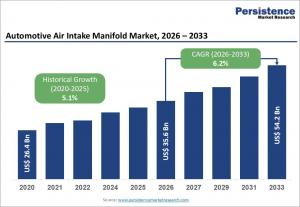
By AI, Created 7:31 AM UTC, June 01, 2026, /AGP/ – Persistence Market Research says the global automotive air intake manifold market will grow from $35.6 billion in 2026 to $54.2 billion by 2033, driven by rising vehicle production, EFI adoption and demand for more efficient engines. North America leads today, while Asia Pacific is the fastest-growing region.
Why it matters: - Automotive air intake manifolds help distribute air evenly to engine cylinders, which supports better combustion efficiency, fuel economy and vehicle performance. - The market is expanding alongside automakers’ push to meet emissions rules and improve engine efficiency. - Rising demand for hybrid vehicles and high-performance powertrains is widening demand for advanced intake manifold systems.
What happened: - Persistence Market Research values the global automotive air intake manifold market at $35.6 billion in 2026. - The firm projects the market will reach $54.2 billion by 2033. - The forecast implies a 6.2% compound annual growth rate from 2026 to 2033. - The report says historical growth from 2020 to 2025 was 5.1%. - The report was published June 1, 2026. - Get the sample report.
The details: - Passenger cars account for about 55% of the market, supported by annual global production above 70 million units and broad use of turbocharged engines. - North America leads with about 35% of revenue, supported by vehicle output, emission regulations and a mature automotive aftermarket. - Asia Pacific is the fastest-growing region because of expanding automotive production in China, India, Japan and ASEAN countries. - Europe remains a major market because automakers there are under strong pressure to cut emissions and improve fuel efficiency. - EFI, or electronic fuel injection, is the fastest-growing manifold type in the report. - The market is segmented by vehicle type, material, manifold type, distribution channel and region. - Vehicle types include passenger cars, heavy commercial vehicles, light commercial vehicles and sports cars. - Materials include aluminum, magnesium, plastic or other composites, and iron. - Manifold types include single plane, dual plane, EFI, Hi-RAM and supercharger intake. - Distribution channels include OEM and aftermarket.
Between the lines: - The forecast points to a market being pulled by both regulation and engineering upgrades, not just overall vehicle volume. - EFI and turbocharging are reshaping intake manifold design toward more precise airflow management. - Hydrogen internal combustion engines could open a new niche for purpose-built intake manifolds if hydrogen investment accelerates. - The report also highlights opportunities in integrated sensors, smarter airflow control and hybrid vehicle production.
What’s next: - Intake manifold demand is likely to stay tied to emissions compliance, fuel economy targets and engine optimization through 2033. - Manufacturers are likely to focus on new materials and smarter air management systems to capture growth. - Request customization. - Market participants named in the report include Aisin Seiki, BorgWarner, Dana Incorporated, Donaldson Company, Lear Corporation, Magneti Marelli, MAHLE GmbH, MANN+HUMMEL, Sogefi Group and Toyota Boshoku Corporation.
Disclaimer: This article was produced by AGP Wire with the assistance of artificial intelligence based on original source content and has been refined to improve clarity, structure, and readability. This content is provided on an “as is” basis. While care has been taken in its preparation, it may contain inaccuracies or omissions, and readers should consult the original source and independently verify key information where appropriate. This content is for informational purposes only and does not constitute legal, financial, investment, or other professional advice.
Sign up for:
Middle East Tech Today
The daily local news briefing you can trust. Every day. Subscribe now.
Check Your Email!
We sent a one-time activation link to: .
Confirm it's you by clicking the email link.
If the email is not in your inbox, check spam or try again.
Welcome back!
is already signed up. Check your inbox for updates.